


Hy’shque Tokitae, Goodbye Sweet Spirit

Ten days, that’s how long it’s been since we were shaken by the completely unforeseen and unanticipated news of Tokitae’s passing. The shock was reinforced by the fact that just thirteen days ago, the Miami Seaquarium released a video telling the world that she was healthier and more active than she had ever been. Over the next two days, they said, she showed signs of discomfort before leaving this world forever. There are no words, and there may never be, to adequately communicate the degree to which this event was not on anyone’s radar. While the health of any captive Orca over the age of thirty is something to be concerned about, Tokitae’s sudden departure was as surprising as learning that the sun had burnt out.
So what do we do with this news? I can only offer my own thoughts, as others who love Orcas and loved Tokitae have also shared their insights. So let us begin.
Tokitae’s home is in the Salish Sea off the coast of Washington State. There are a great multiple of different ecotypes of Orcas across the world’s oceans, possibly ten or more. An Ecotype is defined as a group of killer whales that can be grouped together by their natural history. That is, what they eat, how they forage for it, and with whom they mate. There are three distinct Orca ecotypes living in the waters around Washington State. The first are the residents who are divided into two clans: the northern residents up around the Northern end of Vancouver Island and the southern residents further south of that location. The southern residents are made up of three pods: J pod, K pod, and L pod.
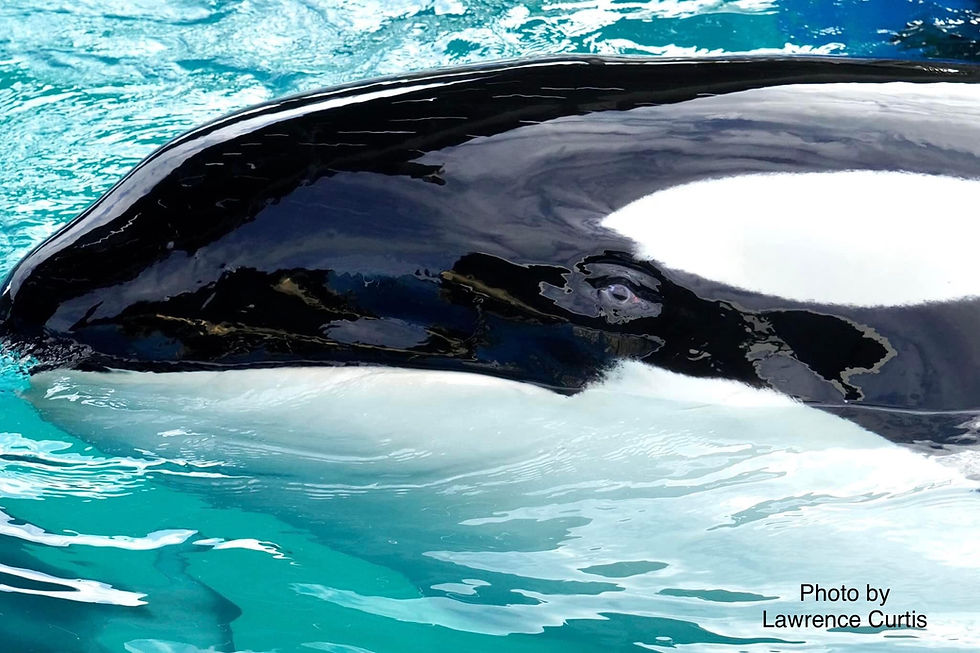
Tokita is a Southern resident from L pod.
These are animals that have evolved in highly and incredibly convoluted, complicated, complex brains, more so than you would expect for the size of their body. A convoluted brain is one with a great many wrinkles and folds that allow for greater surface area and neuronal activity than more smooth brain structures. The only individuals on the plate that have a larger brain than would be expected for their body size are human beings. Even so, Orca brains are more convoluted in areas that are specifically related to memory and emotion and language. Orcas and Dolphins have parts of their brains that are much more developed than ours in the paralympic system, which relates to memories. Scientifically, this tell us that it's possible orcas have richer emotional lives and better long-term memories than we do.
A you couple the morphology of the physical brain as an organ with what we see behaviorally, it creates a general picture that tells us that these creatures are thinking and emotional beings that are highly evolved and highly adapted to their world. They’re highly adapted to each other, socially bonded and capable of feeling grief. They understand time and remember past events.
Different populations of Orcas have different dialects. Some serve the purpose of bouncing sound off of different members of the pod so that they may keep track of each other, while some studies have also shown that some of their calls serve a more sophisticated purpose to exchange subtle information and perhaps communicate emotional states. Orca culture is what has allowed the fish eating residents and themammal-eatingg transients to coexist for so long in overlapping habitat.
But avoidance of conflict is not of course the only role of culture. The southern residents also celebrate together in what appear to be ritual gatherings between pods. These gatherings have become less common in the Salish Sea, Tokitae’s home waters, because of various factors discussed in other articles that make living and eating there more strenuous and difficult. Briefly, these problems are water pollution caused by chemical waste, noise pollution caused by fishing vessels, and a lack of food caused by salmson dying in the four Snake River dams leading to the Salish Sea.
Because of this, Orcas dedicate less time and energy to their celebrations, but they do still occur and these gatherings are called Superpods. One major occurrence of a Superpod was when J35, Tahlequah the orca, gave birth to a new calf in 2020. Tahlequah had previously had a calf that had died in 2018, and she mournfully carried him on her back for 17 days. Upod the birth of Tahlequah’s new calf, J35, members of K pod and L pod came from the outer coast to congregate with J pod.
We can gather from what we know about Orcas brains and what we see in their behavior to reach the conclusion that there is a deep interconnectedness that they share with one another. I and many others who love orcas will be the first to tell you it is a spiritual connection. But whether or not one is inclined to believe that, the bond they share with one-another is observable. It always has been, and it certainly was on Friday August 18th when members of L pod, Tokitae’s pod, were seen socializing and playing with one another as news of Tokitae’s pass reached the researchers on nearby vessels.
Could it be that they know she is no longer confined to her prison? I believe that they do. I further believe that they know her new destination is one of freedom and joy, one that transcends all the suffering of Earthly life. We wanted her to be free now, be free here, but maybe that was more of a selfish want on our part after all she had already been through. Perhaps what Tokitae wanted to know, after decades of living in a concrete pool, was whether anyone loved her enough to rally around her cause. Perhaps, upon learning that human beings around the world were invested in her happiness, she chose to accept this love and go home.
She is missed, but she is also loved. And hopefully, someday soon, our love of her will heal the pain of our new reality so that we may acknowledge the injustice of her life while also celebrating her spirit, both her past journey and her current one.
Hy’sh que to everyone for your support for myself and for one another. I hope this helps to ease your pain on this day.


So beautifully expressed. Thank you💕