


Tokitae's Tale - Triumph & Tragedy

Yes, the price I paid was all I had
But at last, I found release
And if something good can come from bad
The past can rest in peace
Song “Don’t Forget Me”
Performed by Katherine McPhee & Megan Hilty as Maralyn Monroe on “Smash”
1) We Begin
I began writing this article on August 26th with the intention of releasing it within that month. Its release was delayed as the days passed and more critical information came to light, during which time I wrote in extra topics because I felt I could do nothing else. The writing then took on a life of its own, and the result was this very long historiography. For those who loved Tokitae, there is an extremely strained tension between celebrating her life as an individual and admonishing the conditions under which she lived. How do you celebrate someone’s existence when much of it was spent under cruel circumstances they didn’t deserve? Her life, at least until recently, was inexorably linked with an industry of captivity that the Western world has largely come to view as immoral. Yet we all loved her in life, mourned her in death, and condemned without question her continued imprisonment.
Thinking about this brought me to a lesson I learned from a surprising source. It was in a Dollar Tree book entitled, “Before You Judge Me” about sixteen weeks leading up to the loss of Michael Jackson, an artist whose work I delight in religiously and for whom I have immense respect and admiration. Yet contemplating his final years, days, and moments, it is difficult not to allow any thought about him to conjure up a bit of sadness. Due to the sheer mass of rumor and gossip that can surround his name, I was tempted to leave the book where it was. But I bought it, read it, and in its final chapter I discovered an insight that can carry on much further than to one man. The author, Tavis Smiley, stated that he sought to answer the question, “What caused Michael Jackson’s premature death?” In endeavoring to find an answer, he came to the conclusion that the question was coming from the wrong perspective. He wrote, “Given the extraordinary obstacles he faced, the stresses that pulled him apart… what gave Michael the fortitude to prevail for over four decades as an artist of international stature and influence?” It is this perspective that I believe should characterize how we think of Tokitae.
What motivated Tokitae to persevere in her tank for more than fifty years? The answer contains every reason for which she was loved. She was strong, persistent, energetic, curious, and seemingly appreciative of every minor kindness shown to her. These aspects of her, and so many more, drove her to stay until she was truly heard. Orcas are highly individuated souls, and her attitude was simply to never surrender. Through this, she garnered the astonished reverence and love of people, as we shall see, from across the entire world. People watched in disbelief as she remained here as long as she pleased, unwaveringly being who she was at her core despite any negativecircumstances. I am grateful to everyone who brought all of themselves to the fight to bring her home. I am grateful to Chritine Lewis for proofreading this article and suggesting that I add an intro (the one you’re reading), as well as Gina Palmer who also proofread the article and suggested the very beautiful name it now bears. Finally, I am grateful to and for Tokitae; grateful to her because of the movement she inspired and the home she helped me find, and grateful for her who she was and her presence on this Earth. Thank you for staying sweetheart, I’m sorry you had to go.
2) Toki’s Body Lifted
On August 18th, 2023 when Tokitae died in the tiny tank that had been her forced home for 53 years, it was quite remarkable to see how quickly she could be transferred for a necropsy. On that same afternoon, just mere hours after her passing the pool was drained until about two feet of water remained. Her lifeless body was put on a stretcher with an all-too-familiar shape for those who have seen orcas captured and transferred before. It was all white material bordered with two black poles for the purposes of being lifted by a crane, as well as two cut-outs for her pectoral fins. That same night, she was transferred to the University of Georgia for a necropsy, which are required by law for deceased orcas. As heart wrenching photos and videos broke of her evening transport, protestors could be seen outside holding signs labeled “shame.” It was impossible not to wonder why this couldn’t have been done before. Why couldn't such a swift move have been made while she was alive?
Of course, there are many answers that can offer comfort to those who were in charge of Tokitae’s wellbeing. Her health needed to be monitored, she needed to recuperate, permits needed to be acquired, details needed to be figured out, and so on and so forth. These reasons, and all the minutia can be contemplated until anyone even remotely related to this tragedy can wrap themselves in a warm blanket of denial so thick that there's no reason they should ever have to feel a sense of responsibility again. But underneath all of the intricate excuses lies one fact- They took too long!
Tokitae did her part; she exercised, both with her trainers and on her own without prompting. While she did fall ill several times, she always pulled through and was at least on a progressive incline as far as her health was concerned. She lived far longer in captivity than anyone could have reasonably anticipated, especially given that she was in the smallest orca tank in the world. In the end, she could only wait so long. The degree to which it is obvious that too much time was taken is only paralleled by the shock waves Tokitae’s death sent throughout the world.
There’s no real way to prepare for something like this, especially with older captive orcas. Tokitae was estimated to be 57 when she died. The life expectancy of any captive orca older than 50 is difficult to determine because most of them die before then, and quite frankly it is a small miracle when they make it past 30. Moana, an Icelandic killer whale at Marineland Antibes in France, passed away on October 18th at 12 years old. In the wild, they live much longer. The Southern Resident Orca L25, Ocean Sun, is believed to possibly be Tokitae’s mother and could be nearing 100 years of age.
3) It Seemed Inevitable
As has been discussed before, but what might be lost in time and memory was how completely certain everyone involved was that Tokitae would once again feel the motions of our earthly sea. Howard Garrett, one of Tokitae’s chief advocates that some may know from the documentary Blackfish (a film that exposed the negative sides of orca captivity and left the industry with a black mark from which it has never financially recovered), recently did an interview with Sky News. In it, he discussed the possibility of Tokitae being moved within a few months:
“I've been elated for about a year and a half now, since developments started to happen that made it inevitable that she will be coming back here to where she was captured in the Pacific Northwest.”
Alejandro Ariel Dintino one of Tokitae’s most dedicated supporters who has protested for her release since 2014, posted that interview on Instagram with the following caption:
For nearly a decade Alejandro has been protesting for Tokitae's release using various mediums, one of which bystanding across the street from Miami Seaquarium in a prisoner’s costume with a blow-up whale in a net. The idea was that she was a prisoner, and he thought the imagery would catch people’s eye. He was right. “Love makes you do crazy things,” Alejandro once remarked in an audio-biography entitled Tokitae made by Bonnie Swift. I remember her (Bonnie) speaking with someone else who said, “She’s probably going to die in that tank” and I thought he was so completely wrong.
Overall, the overwhelming spirit of the past months has been it wasn’t supposed to end like this. On the day of Tokitae’s passing, I remember reading the headline from Sacred Sea Conservancy that read, “A Great and Sudden Loss.” Probably half a dozen interpretations of that statement ran through my mind; perhaps Li’i had died, perhaps a member of the Lummi Nation had died, perhaps an employee of the Miami Seaquarium had died. Only when my eyes fell on the sentence, “Sk’aliCh’elh-tenaut (Tokitae/Lolita) has walked on” did I realize what I was reading, and it was as shocking as it could have possibly been.
Jennie Holt is a member of several Orca groups on Facebook, and her reaction to the news contained a passion that was quite representative of the waves of sorrow brought by this irreversible new stage.
The unexpected nature of her passing was partially due to how difficult it is to calculate how long a captive orca will live once they survive into their 50's. It is so uncommon that the future really is hard to predict. However, there is another side to this story that I did not anticipate discovering.
I will admit that in all the jubilation and celebration involving renewed hope for her release, I had not actually read every veterinary report. Upon closer examination, for at least the last three months from May to July she was dealing with persistent abdominal discomfort, an (albeit shrinking) lesion in her lung, and a very low white blood cell count. It is clear that the August 15th video update claim that, “it seems like she is better than ever right now” was untrue at best and an outright lie at worst. For the record, the Miami Seaquarium has since taken down that video. Worry not, however, because I have the video file (and so does the Facebook page Until Lolita is Home) in case anyone would like to challenge the bit of information.
4) Decades-Long Fight
Tokitae was in her tank for a long time, since 1970 in fact. This past August 4th marked the 53rd year of her captivity. The day of her capture was sunny, quite windy, and had a temperature throughout the day that measured between 53-64 degrees Fahrenheit (12-18 degrees Celsius). Yes, I looked it up. Since her capture and relocation to Miami Seaquarium on September 24th of 1970, she spent all her time in a tank that is not even the size of a basketball court under the blistering Miami sun. For five decades, she resided there. For every event this reader may have been to in the last fifty years, Tokitae was swimming in the same cramped space.
It is remarkable to me how salient that fact has become. The other day, a friend mentioned to me that they lived in Florida for six months a few decades ago. All I could think was, “My God, Tokitae was still there back then.” While I have known for some time that protests for her release began almost as soon as she got there, I didn’t know how involved such protests were. It is easy to think of demonstrations today as only being partially physical, as many of them involve the fuel of online participation.
This is not necessarily a bad thing. As we shall see later, it is the internet that allowed Tokitae’s story to be heard the world over and mount pressure for her release. But many who were in the movement to begin with, including most who were added along the way, participated by showing up. They needed to be somewhere to make a point and have it be heard. I myself would not have known about Tokitae and her journey without hearing about it online. One day, I and many others didn’t know she existed, and the next we had everything invested in an orca we had not yet, and now will never, meet in person.
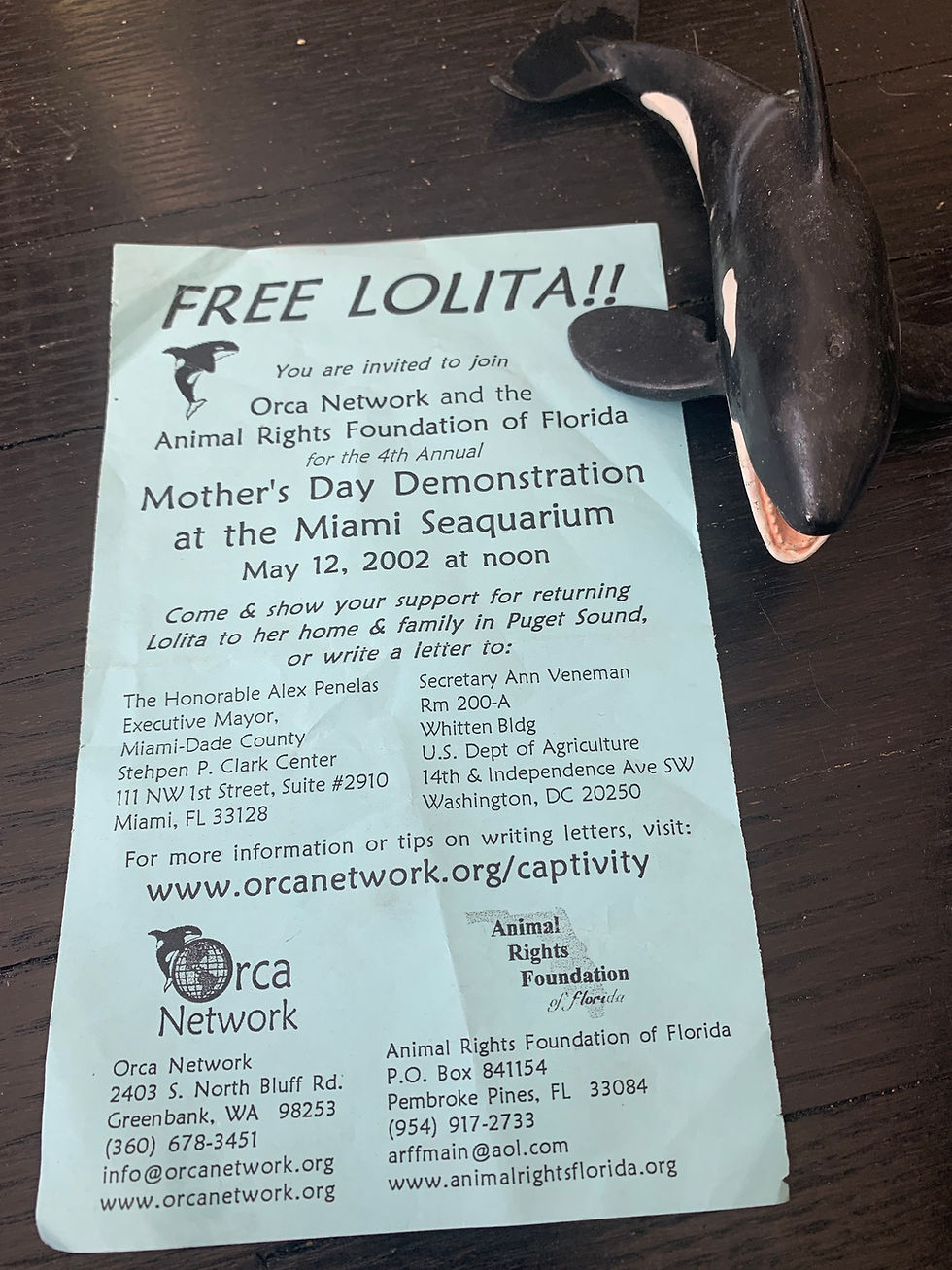
But even as relatively recently as 2002, the lifeblood of the movement came from people who were willing to take time out of their day to stand somewhere and be her voice. One such person is Niki Gianni, who shared this photo of a pamphlet from May 12th, 2002. It was a Mother’s Day demonstration at the Miami Seaquarium, an event organized by the Orca Network.
Michelle Seidelman has also collected paraphernalia from the many rallies she has attended.
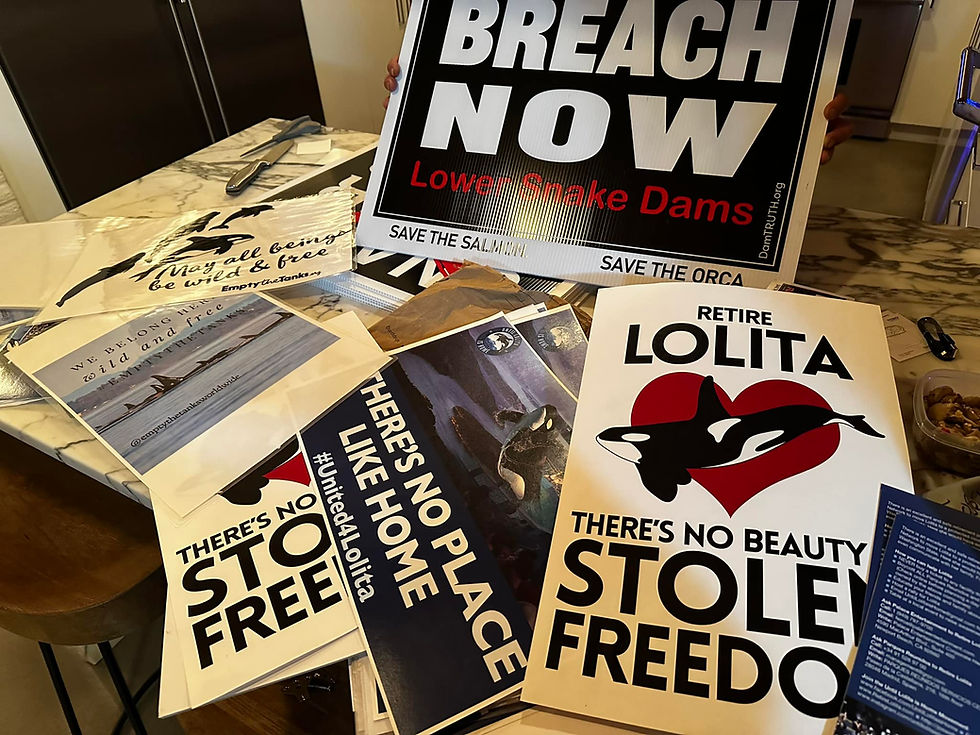
One of those rallies includes a “Rally for 74” demonstration which she organized herself. It was for the remaining 74 Southern Resident Orcas was held on the steps of the Temple of Justice Friday in Olympia, Washington.

The unique aspect of the southern resident population is that we know all their names. In the photo above, Howard Garrett stands in front of protestors holding Orca profiles with individual names written on them. According to Mrs. Seidelman, all the orcas are still in one piece and in storage.
5) Li’i Alone In The Tank

A new source of uncertainty was the remaining Pacific White-Sided Dolphin named Li’i who was Tokitae’s tankmate. Li’i has been at the Miami Seaquarium since early 1989 and is now in the same tank Tokitae died in. While Pacific White-Sided Dolphins and Southern Resident Orcas would not typically congregate so closely to one-another, Li’i and Tokitae were together for a long time and the fact that Li’i is still alive is a testament to how Tokitae must have felt about him. She did not take her frustration out on him. If she had, their size and weight differential would have led him to pass on before she did.
In the aftermath of Tokitae’s passing I was surprised and encouraged by the endless stream of posts and advocacy I saw in favor of Li’i’s release, asking that people not forget that he deserved freedom too. One such person was Rune Cuthrell, who I encountered on Facebook on a post where they communicated that they had emailed at least 60 different newspapers about Li’i’s predicament. In a statement I received by request, they said the following:
“After Tokitae died, I felt so hopeless and like I couldn't do anything as just one person. I woke up one day and she'd suddenly shifted my whole mindset. I decided to try everything I could to help her dolphin friend Li'i. Before I knew it, I'd connected with so many amazing folks who cared just like I do and wanted to help. My lifelong dream has been to help cetaceans and be a marine biologist. It's been wonderful to feel like just one person can make even a small difference and raise a voice.
I've sent about 400 emails to local elected officials in Miami, NOAA, WHOI, several aquariums, newspapers, news outlets, animal rights groups, the USDA, the White House, members of Congress and Jim Irsay. I've signed petitions urging for Li'i to be sent to Shedd Aquarium and filed animal neglect complaints through several entities like the Humane Society. I've tried to reach quite a few celebrities in the hopes that they'd also help raise awareness.
I've tried absolutely everything I could think of.
I've urged everyone I've contacted to help raise a voice to spotlight how poorly Tokitae and now her friend Li'i have been treated. An important step in changing the future for our captive friends is showing others the horrors of places like Miami Seaquarium.”
Their remarkable effort has paid off. In addition to receiving replies from the Miami Mayor’s Office and the Jane Goodall Institute, her Letter to the Editor was published by the Detroit Free Press ".
6) A Good Victory
We now know that Li’i the dolphin has been relocated to SeaWorld San Antonio. On September 25th, the Miami Seaquarium released this statement:
While SeaWorld is a far cry from a sea sanctuary (indeed, someday soon we will have to take SeaWorld to task regarding their captive Orcas), it is exponentially better if only for the company Li’i will have. Our community should be very proud. Without missing a beat, and with grief in full swing, we were there to advocate for Tokitae’s friend.
7) Pritam Singh
Pritam Singh is the founder of Friends of Toki, a group formerly dedicated to her release, he is also a land developer and owner of Isla Bella Beach Resort in the Florida Keys. He acquired the property for 24.5 million. He donated just 1 million to Tokitae’s release efforts, and the Isla Bella Beach Resort includes the Dolphin Research Centre. In the captive cetacean industry, it is often difficult to discern between abject ignorance and deception. In my conversation with an employee at Seaworld, she did not mention that Nakai was Tilikum’s son. Whether or not Seaworld employees are instructed to limit the mention of Tilikum’s name is something I will never know. When we discussed Orkid, I mistakenly remarked that Orkid had one blue eye and one brown eye. After telling me that she always discussed the orcas with her mother like they were her children, she casually remarked that she did not know what color Orkid’s eyes were (as it turns out, they are both brown).
I bring this up because it is part of a larger pattern in the captive cetacean industry. The Dolphin Centre portion of the Isla Bella Beach Resort boasts an, “all-natural, outdoor setting” located at, “a secure, natural seawater lagoon.” This vaguely positive language distracts from the fact that the dolphins are still not free to go, they are captive. It is only a marginal improvement dolphins’ health and wellbeing that they are enclosed in a lagoon rather than a tank. The dolphins on Pritam Singh’s property are Bottlenose Dolphins, which are not endangered and have a population of around 600,000 worldwide. Any claim to be protecting them would be false anyway, but this fact makes any such assertion impossible.
8) Eduardo Albor
Eduardo Albor is the owner of The Dolphin Company that recently purchased the Miami Seaquarium. The Dolphin Company’s contribution to dolphin captivity is somehow even worse that Pritam Singh. On their own website, I counted no less than 22 resorts with captive dolphins, and several more that appeared to have dolphins in aerial shots. The idea that Mr. Albor was going to be a champion for Tokitae was always going to be hypocritical and problematic. There is very little press afforded to the cause of freeing captive orcas, dolphins, and other cetaceans. What little press there is tends to be granted to orcas. However, dolphins are just as intelligent and social, and the effects of captivity are just as deleterious on them. Most of the emphasis on orcas is, I think, primarily psychological. Orcas are very large, they’re very beautiful, and quite frankly they look a lot like whales. The most commonly known name for them, killer whales, has resonated in our societal lexicon because Seaworld likely saw a profit motive for referring to them as whales rather than orcas.
9) Eduardo Albor’s Post.
What little we have heard about him casts doubt on the man’s character. On August 21st Sandra Dianne, a user on X, posted the following:

Mr. Albor responded with this.

Whether or not English is Mr. Albor’s first language, his intent is clear. He joked about keeping Li’i the dolphin captive for another half a century. For those who don’t know, the oldest recorded male Pacific White-Sided dolphins life was 42 years old and Li’i may be as old as 40 already. The response online to Mr. Albor’s comments were equal parts shock and offense. Most of his previous remarks were limited to written statements and reposts at a time when many did not know him as the face of the Miami Seaquarium. Now that his less filtered remarks have garnered attention, it seems that he is not as empathetically hearted as one would have assumed. I reached out to him on X for comment on August 29th, but have never heard back.
10) An Unfortunate Duo
This all adds greater understanding to the people we were relying upon to set Tokitae free. Pritam Singh and Eduardo Albor both have significant financial investments in captive cetaceans. There was and is a significant conflict of interest. During Tokitae’s journey, those of us watching Tokitae’s progress were under the impression that even if her benefactors didn’t care about her, they at least had a vested interest in her wellbeing. We now know that not only was that not the case, but there may have been a plan in place regardless of what happened to her.
11) Back To Football
Jim Irsay, owner of the Indianapolis Colts and the benefactor who would have been the financial backbone of Tokitae’s move, also had no further remarks to make about Li’i. The day of Tokitae’s passing, he posted what appeared to be a heartfelt paragraph about all the lives she touched with her story, but was back to promoting the next day’s football game less than four hours later. Yes, he has a business to run and yes, he was the only philanthropist who stepped forward, but in the end he spent no money of the $20 million he committed and the time he spent shedding a spotlight on her ended as soon as she left us. An entire 44-second video detailing his love for her and the responsibility those of greater means have to those with less means on this planet and in the end, one 66-word post and a forgotten dolphin.
12) No Permits Filed
This brings us to new concerns about how exactly her health and future transfer was being handled. According to contact that I and others have had with the NOAA Fisheries, no permit to move Tokitae was ever filed. In addition to this, the tank and bowl still haven’t been repaired. In April, Miami-Dade County’s Unsafe Structures Board gave Seaquarium a deadline extension to the 17th of August, one day before she passed.
13) Cause of Kidney Failure.
It has been no secret that Tokitae had been on hard antibiotics in the past. On September 30th of 2022, Miami Seaquarium reported that Tokitae was on antibiotics for a chronic infection and that she had a stable appetite. On October 2nd of 2022, they reported that her overall health was stabilized by the antibiotics but while her condition was, “not considered critical, her appetite has decreased.” This was, to say the least, a very worrying period of time for those that have been rooting for Tokitae’s freedom. All of the faith, hope, and much-needed improvements to her living conditions were riding on pulling through a health scare from an orca that was long overdue for release.
She pulled through that not-insignificant health scare, and at some point the decision was made to feed her less fish since she was no longer performing to the public. Dr. Jenna Wallace, one of the whistleblower vets fired from the Seaquarium before its acquisition by The Dolphin Company, believes Tokitae was suffering from dehydration. While we will know more when the results of University of Georgia’s necropsy, the preliminary picture we are getting indicates that poor forethought contributed to her death. Tokitae was retired from public performances, fed less fish, suffered a chronic infection which was combated with heavy doses of antibiotics, was possibly dehydrated, then died of kidney failure. I dearly hope that this narrative is off by several hundred orders of magnitude, but we will have to see.
14) August 18th.
Workers at Miami Seaquarium panicked as water in Tokitae’s whale tank was raised after an urgent medical procedure on August 18. She struggled to swim independently and floundered as the water rose, and part of her jet-black tail appeared limp. Already exhausted from a chronic infection, she had survived multiple hurricanes and nine U.S. presidencies. It was five decades of repetitive performances. "She was having trouble moving one fluke particularly. She was not as active as we would have liked. She was clearly uncomfortable, listing to one side," said a source to the Miami New Times.
The situation was further complicated by the leak of a bulkhead used to raise and lower the level of water during medical procedures. "We began to lower the water again, and there was concern that with the leaking through the bulkhead, it would not lower as quickly as needed, but it did. We were able to get the water down," a witness to the Miami New Times reported. The veterinarians scrambled to control Tokitae's vital signs and irregular breathing while a whale-size stretcher was brought in. However, Tokitae never recovered, and she died around 4 o'clock that afternoon.
Miami Seaquarium released a statement saying that "despite receiving the best possible medical care," the orca, thought to be 57 years old, died from "what is believed to be a renal condition." Medical procedure immediately preceding her death was not mentioned in the marine park’s statement. Tokitae, according to all reports, had been struggling for two days prior to her death, but did not succumb to her conditions. As a result of her lack of appetite and languid appearance, her veterinarians scheduled her
August 18 appointment, which involved drawing blood and administering medication and fluids. She died suddenly, which raises questions about the cause of her death. Tokitae's veterinarian of over 20 years, Magdalena Rodriguez, has raised concerns that medical examiners should suspect medical complications might have been involved in the whale's death. The orcas are conscious breathers, meaning they move to the surface to breathe through their blowhole, which is similar to a nostril. If a killer whale falls unconscious or becomes incapacitated for an extended period while submerged, it will drown. During a medical procedure in which water is lowered and then raised, you have to make sure the whale is breathing well. If the animal is struggling, the water must be lowered fast.
Rodriguez was not present at the time of the procedure. Seaquarium's former owners fired her in 2021 after she claimed the park was endangering its animals by reducing their diets. A 2021 inspection report was filed by the U.S. Department of Agriculture (USDA). "We know she was sick," Rodriguez says of Tokitae's final day. "But it was a cascade of things going against her. She likely was losing consciousness, having trouble breathing.” It is estimated that several similar medical procedures had been performed on the whale without incident prior to her death, according to the source who witnessed her passing.
"We assumed she'd have the same positive response she'd had previously when treated this way. The days leading up to this did not indicate this level of illness. There were blood tests. There were all the things that we review and inform the treatment for the vets. There is nothing that was done that was ill-advised or in any way reckless and without thought and consideration." According to Rodriguez, blood was seen around Tokitae's mouth following her treatment that day, indicating a possible hemorrhage or adverse reaction to her medication. Tom Reidarson, a Seaquarium lead vet who works for the aquarium, said that Tokitae was "in as good a clinical condition as I've ever seen her." Reidarson said, "She was quite sick in October of 2022 and recovered quickly. She had a slight setback about a month ago and again recovered quickly."
In an NBC 6 report, the Seaquarium said 15 clinicians and pathologists were assigned to the necropsy. Necropsy results have not yet been released by the Seaquarium. In August, the park said the whale's remains would be cremated and shipped west under the supervision of the Lummi tribe. The National Oceanic and Atmospheric Administration's (NOAA) Fisheries stated in early October that the Seaquarium had not provided the necropsy results to NOAA. A public outcry against whale captivity and exhibitions led SeaWorld to stop its orca breeding program in 2016. MarineLand's last captive orca, Kiska, died in March, roughly three weeks before Miami Seaquarium announced its deal with Irsay to transport Tokitae. As Rodriguez reflects on Tokitae's final days, he wonders whether the rosy portrayals about the whale's health were more than lip service to feed the narrative that the whale was free.
He asserts that either the public has been misled to think she was healthy, or her caretakers were clueless and believed she was healthy when she was sick. "She died an awful, agonal death and did not deserve that." With so much hope on the line and a release project underway, the ordeal was devastating. It was and remains a testament to the whale's will to survive that she persevered in her small tank for all those years. Her life was longer than almost any other orca captured during a time when hunters were selling juveniles to marine parks for top prices.
"Tokitae found a way to live in a place that everyone now seems to agree she should never have been, was way too small. Something about her and her will to live was palpable when you were with her and just made you fall in love with this animal," the source for Miami New Times said. "For so many people around the world, this whale became iconic. It's like you're treating your mother, grandmother, your sister. We were remarkably and appropriately optimistic about her future. But it did take a serious turn."
15) Conspiracy Theories.
I use that term with no derogatory intent. From unwise words of the Seaquarium’s new owner, to the fleeting attention of a wealthy benefactor, all the way to expired permits and the potential of a critical error in judgment regarding Tokitae’s health, has left a great deal of room for speculation. This speculation includes the theory that this was all a publicity stunt and that there was never a good-faith plan to bring Tokitae home. I have no particular interest in defending the reputation of anyone involved in this fiasco except the Lummi Nation, the Orca Network, and Friends of Lolita. The indigenous Native Americans and the two Orca groups headed in part by Howard Garrett had every reason to believe that Tokitae would return to her home waters. As for everyone else, all I can say is that there has been plenty of botched care regarding Tokitae over the last nearly thirty years, and right now we have been given no information that indicates that anything other than chronic apathy was at work. If we find out that someone acted with more malicious intent than that, they should be prosecuted and punished to the fullest extent that is legally allowed.
I have not checked in on social media every day since Tokitae’s passing, but I have noticed some heated discourse surrounding the day and moment of her passing. There is great concern among many that the truth is known, and that has lead to some argumentation in our community about who is reading too much into what is fundamentally unknown or who is paying more attention to the facts. I will say this: when information is withheld, no one can be blamed for assuming that is due to malicious intent, nor can anyone be blamed if they decide to exercise restraint with regard to their conclusions in light of a lack of information. Her regular vets weren’t there, and Eduardo Albor had many people sign NDAs. We may never know the full story. Everyone here loves Tokitae, and I strongly plead that no one casts judgment on any camp that believes one thing or another about the unfortunate gap in our knowledge of the day of her death. Tokitae was and is our great unifier, do not let her last moments define how you interact with those who also care deeply about her.
16) Necropsy Report
The necropsy report for Tokitae, completed on August 19th, was released on October 17th. It reveals a number of things, the first of which is that she had pneumonia. This was at least one of the chronic infections for which she was being continuously treated. She was also suffering from kidney degeneration, likely partially aggravated by the triage of antibiotics she was being given. Her heart valves were also not functioning properly, a condition clinically described on the report as, “cardiac valvular degeneration and endocarditis.” These are the three conditions on her report that are listed as the primary cause of her death. There were fourteen other health issues listed that I will not exhaustively discuss because there is little point in that exercise.
The most notable aspect of the report came from the notations at the bottom of the page under “comments.” An entire paragraph was dedicated to what was essentially an editorialization of the medical findings. It read as follows (note that the typo in the final sentence is in the report itself):
Autopsy reports should only provide information about what an individual’s body can relay about how they died. It should not give context, a play-by-play of events, nor hypothesize some ethereal cause of death not made obvious by the medical facts. What you have just read is a profoundly insulting and astonishingly transparent attempt by the report to frame Tokitae’s death as the result of comorbidity.
17) Best Laid Plans
I have hesitated to finish this article, writing about her has partially distracted me from our harsh reality. But no matter how much I reflect on our fight, it is still over. No matter how many times I contemplate our route, it reaches the same destination. No matter how much I write about her, she is still gone. I miss fighting for her physical wellbeing. I miss the sense of purpose that came with waking up knowing that she was still with us. And maybe, perhaps, that is the selfish side of grief. There is no doubt that people who wanted her to be free had her best interests at heart. However, there is still a sense in which we were asking her to hold on for our sake. Every day that we woke up hoping for her release, she still woke up in a cage. Furthermore, we are still fully capable of moving for her spirit. The best thing we can do for her is not give up on those who still need help, those who are in the same situation she was in just a short time ago. This will never be okay, but the fight is not over.
Tokitae’s departure is far from the first death in recent memory. Hers is the most major in our country, but on the afternoon of March 10th, 2023, Kiska passed away in Canada. She was their last surviving captive Orca. That was difficult enough, and I admit that it takes time for me to assimilate my thoughts into a coherent stream. As such, I was in the process of writing something about Kiska, and this is part of what I wrote in my research for that article:
“Kiska and Tokitae are similar in that they both experience isolated existences, but there has always been great worry over Kiska’s health. Being completely alone, as opposed to Tokitae who at least has two Pacific Whiteside Dolphins, must have been very deleterious for her health. Now that Kiska has passed on, there will likely be an increased intensity to those lobbying for Tokitae’s release. They are sisters of the sea, and on the day that Tokitae sees freedom, many of us will be thinking of Kiska.”
We now know that day will never come. A day will come, however, that an orca is released from captivity and put into a sea sanctuary. I believe that with everything in me, and the day I give up on that will be the day death takes my body. I think many people feel the same way. The cracks in the captivity industry’s castle are quite visible now, we need only push one the walls at the opportune time. Until then, we would do well to stick together and be kind to one another.
18) The Path Forward.
It is entirely possible that we have been too gentle in our approach to lobbying for the release of captive orcas. Part of this strategy has been in an attempt to refrain from dissuading anyone who might like to help us. If we emerge out of the gate with a spiteful expression and angry words, it’s possible that we might discourage the uninformed from getting involved if the first thing they see is our anger before they understand why we are angry. Theodore Roosevelt once wrote, “I have always been fond of the West African proverb: "Speak softly and carry a big stick; you will go far.’” I think that pretty well describes what we have tried to do. That being said, it is probably time that we invest more emphasis in what we carry than how we speak. The lives of captive Cetaceans depend on that.
19) Calls To Her Family.
A representative of the American charity organization Until Lolita is Home, Dr. Claire Paris-Limouzy, attended two press conferences it organized in support of Tokitae. By the end of March, she visited the Whale Bowl by invitation, where she recorded a sound clip of Tokitae, one of the last recordings of her vocalizations that were made before she passed away. Tokitae made her voice heard in the Southern Resident community by calling out to her family with the vocalizations that she had learned from her mother and all others who lived in that region. Even though she was young, and even though learned those calls decades ago, she never forgot how to voice them. Her readiness to return home was always evident.
20) Breach the Dams.
Ted Griffin is the man who led the captures off of Washington State that brought us Tokitae and led to the deaths of several orcas in capture nets. His captures are perhaps the most profound reason that Southern Resident Orcas are on the brink of extinction. He spoke about this whole ordeal recently, and readers will be forgiven for assuming that his private life included quiet regret. His only new remarks were that he was not sorry for capturing Tokitae but was sorry that some orcas had died in his captures. Why someone would possess the nerve to say something so asinine at such an insensitive time is anyone’s guess, he should have continued to keep to himself.
We are now left with what to do with all the energy we have invested into Tokitae’s release. One way is to protect and care for the family that she still remembered. Southern Resident Orcas were recently categorized as a sub-species of orca. With their population dwindling, it is becoming increasingly clear that drastic measures must be taken in order to ensure their survival. One of the most important and beneficial steps towards helping the Southern Resident Killer Whales is to breach the three lower Snake River dams. The southern residents rely heavily on the Chinook salmon for survival. Unfortunately, four dams built on the lower Snake River have blocked off these essential fish from reaching their spawning grounds, leading to a dramatic decline in their population. The breaching of these dams will allow more salmon to return to their spawning grounds, which in turn will provide the orcas with a much-needed food source. The current amount of salmon available to the orcas is low and insufficient, and the breaching of the dams will provide a significant boost to the salmon population in the area.
A 2015 study found that the birth of nine calves would require at least 30,000 more Chinook per year, and if wild and hatchery Snake Chinook fall below current levels, the orcas’ diminishing numbers will certainly have an impact on viewership and economic benefits. The four lower Snake River dams must be breached to restore the health and wellness of the Southern Resident Orcas. Furthermore, breaching the dams would increase recreation and tourism opportunities, create jobs, and generate tax revenue for the region. It is essential that action be taken to breach the three lower Snake River dams to restore the local economy and ensure the survival of the Southern Resident Orcas. This increase in salmon will provide the orcas with a reliable and plentiful food source, helping to keep their numbers up and their population thriving.
The dams were constructed over 40 years ago, flooding thousands of acres of once-vibrant agricultural valley, destroying villages, and displacing salmon that these whales rely on for food. Due to the dams, the region has experienced economic morbidity with declining per capita income, smaller and mid-size farms, and empty properties in small towns. The benefits of breaching the dams go beyond helping the orca population. It would increase recreation expenditures in the six counties adjacent to the lower Snake River by at least $400 million annually, supporting between 3,000 and 4,000 jobs in the surrounding counties. Improved fishing in the Snake and its tributaries could generate $544 million annually. Additionally, the cost of irrigation system modifications would be reduced from an estimated $291 million down to $19 million, allowing for the irrigation of an additional 5,000 to 7,000 acres and creating more jobs, tax revenue, and higher incomes.
The Biden Administration can take action to breach the lower Snake River dams by exercising executive authority as Commander in Chief pursuant to the US Constitution Art. II, § 2, cl. 1, and in accordance with the National Emergencies Act, the Endangered Species Act, the Antiquities Act, and the River and Harbor Act of 1945. The Army Corps of Engineers also has the discretion to stop funding the dams, place them in caretaker or non-operational status, and secure them by breaching in accordance with their obligations under the Endangered Species Act and the River and Harbor Act of 1945. The breaching of the lower Snake River dams is a necessary step to help save the Southern Resident Killer Whales, create jobs, and help the economy of the surrounding area. It is up to the Biden Administration to take action and ensure that the breaching is done in a way that is beneficial for all involved.
21) Among The Clouds
Throughout the months since Tokitae’s passing, some people have posted photos of what they’ve seen in the sky. Perhaps familiar shapes from a resting spirit.

“Sk’aliCh’elh-tenaut is together with the Salish Sea! Ancestors are happy, her family is grateful, the healing begins!” - Squil-le-he-le (Raynell Morris)
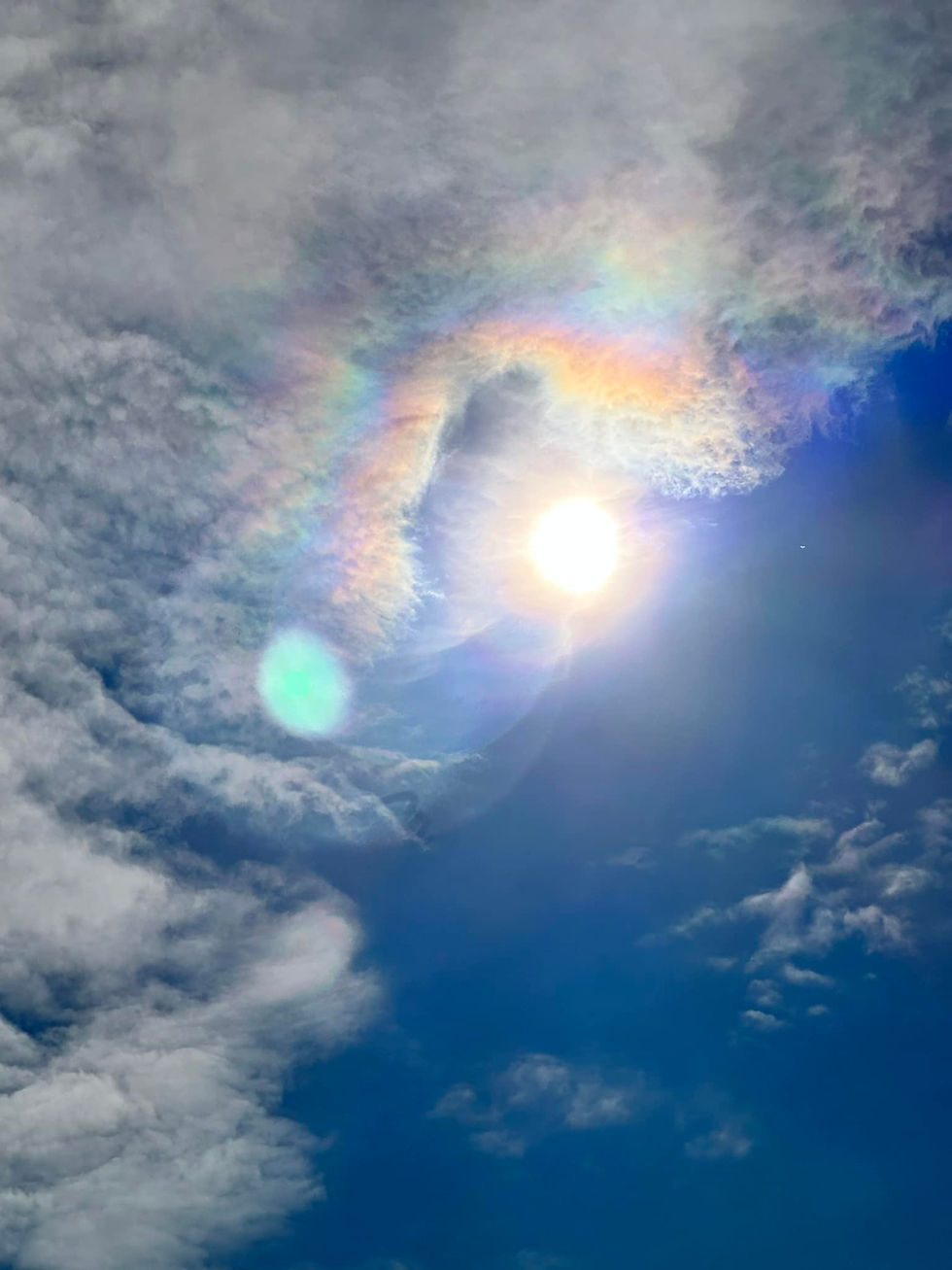
“Ancestors, Sk’aliCh’elh-tenaut and the Whale people were showing themselves in and around the sun yesterday. I went to Xwe’chi’eXen (Cherry Point) to pray and give gratitude for their guidance for helping me bring Sk’aliCh’elh-tenaut back to the Salish Sea. 🙌🏽 \💙” - Squil-le-he-le (Raynell Morris)
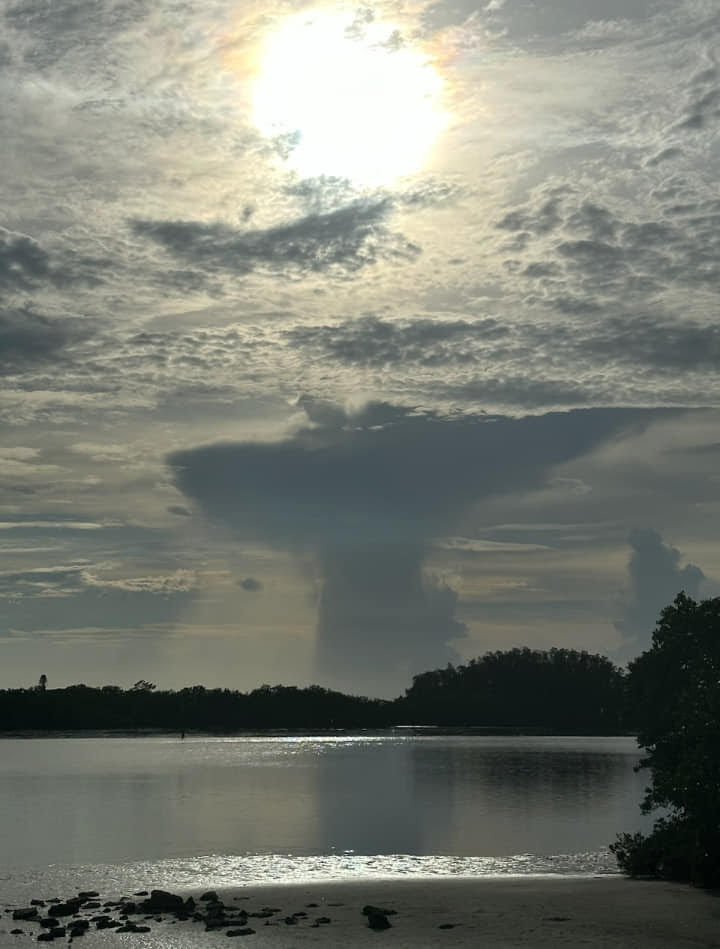
“Beautiful Whale Tail cloud taken on Thursday by my friend Jen Wincey Rodgers she said she thought of Lolita when she saw it & took this picture!” - Stacia Pride

“St Bee's, UK, yesterday 😊 well, my brain sees it ❤️” - Amy Diane Walker

“Sunday morning 27th Aug UK. Not sure if you see it ? My first glance at the sky & I saw a whale & said ‘Toki.’” - Emma Riley
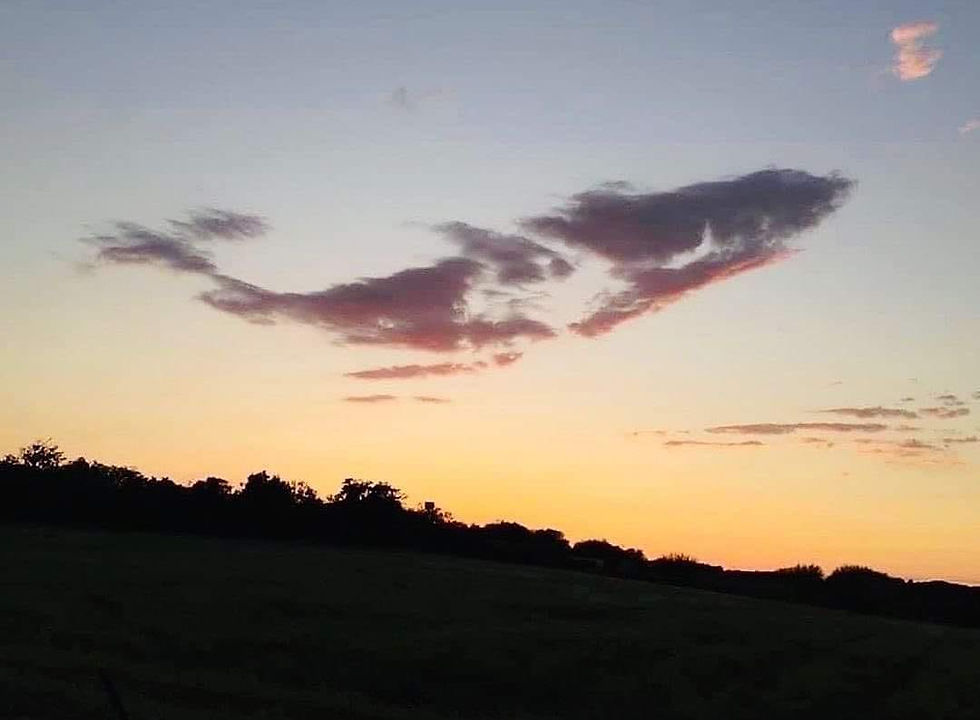
Ocean Angel: “Tokitae?” - Photo: Chris Briden

“Strait of Juan de Fuca” - Tiana Rasmussen

“✨ She is Well ✨ She is Whole ✨ She is Home ✨”
Tonight in the Salish Sea” - BryAnn Bingham
These photos are nothing short of remarkable. The timing and widespread nature of just how many were seen in the sky is like nothing I have ever seen before.
22) Love From Around The World
April Basham
“Loving her forever and always from where she belonged. Here in the Salish Sea in Washington State.”
Diana Armstrong
“With love from Ontario, Canada.”
Stacey Hansen
“With love from the Okanagan Canada 🇨🇦”
Linda Chiavatti
“From both Ontario Canada and Clearwater Florida…”
María Papadopoulos
“Sending love from Germany.”
Liz Pelonzi
“Love you Toki. Will always ❤️ from New Hampshire.”
Kylie Gamble
“Miss you tokitae so much and love you so much ❤️😘 from Indiana.”
Gina Palmer
“Tokitae, you will live on. Swim free beautiful girl.. with love from Idaho.”
Niki Marie
“Love from Chicago ❤”
Cindy Barker
“Love from from Arizona”
Janet Pether
“Love from Sydney, Australia.”
Ellen Crow
“With love from Orlando.”
BryAnn Bingham
“Love from the Salish Sea, Hansville, WA.”
Derek William Law
“Aberdeen, Scotland.”
Jonathan Pastor
“I am reading you from Madrid-Spain.”
JennyJen Potter
“Thank you beautiful Tokitae for changing me for the better, love you always & forever love from Maryland ♥️.”
Raewyn Fraser
“Love from New Zealand.”
Elly van Reenen
“We have to honor Tokitae❤️🐋 I'm from Alkmaar, The Netherlands.”
Christine Lewis
“Toki, your story touched me deeply. You made me aware of the plight of your family, I'll always be an advocate for them. With love from Lancashire, England.”
Michelle Seidelman
“Love you Tokitae with all my heart 💔 I fought hard for you… I organized and attended so many rallies. I feel like I failed you greatly. I am sooo very sorry. My biggest wish was to see you swim free with your family and I will continue to fight for them always… you guys were the reason I was born. Portland Oregon”
My whole life, Orcas have spoken to me, whispered to me in one way or another. These last two years, they follow me in my dreams and show me one thing or another. I reignited my social media presence 3 months ago, and the best part has been knowing I’m not the only one they speak to.
23) A Day of Freedom
On the morning of September 22nd, at 7:00 am, an Orca was found stranded north of Gilsfjarðarbrú, Iceland. The Icelandic Association for Search and Rescue was en route to the whale and had planned to attempt to refloat it at a later time in the day. In spite of the fact that the whale was mistakenly believed to be deceased, it was thought to be a young juvenile whale. At 9:00am, it became unclear whether or not the Orca was still alive. It has been reported by a local that a pod of seven orcas has been spotted in the area five days ago, according to a local report.
That same day, Tokitae’s cremated ashes were transported to Washington State under the watchful auspices of Squil-le-he-le (Raynell Morris), and arrived at Bellingham International Airport at 10am. Raynell is a member of the Lummi Nation, and has performed traditional ceremonies for Tokitae for years. Some were done off the coast of Florida, and some were done at the Miami Seaquarium.
At 11:00am on the day of the stranding, a crowd gathered around the stranded Orca as the day progressed. The Orca’s respirations were good, which confirmed that it was doing well. There would be an attempt to refloat it on that same night. In the meantime, the locals were trying to keep him wet and calm. During an interview with Dr. Edda Elsabet Magnus, a whale biologist, she explained that, "At first glance, it seems to me that this is a young and quite healthy male. He is an adolescent, so not young, but considering his dorsal fin, he still has some way to go to reach full size." It was 4pm when search and rescue began attempting to refloat the stranded orca in an attempt to save him. The planned public ceremony for Tokitae was rescheduled for a later date, but the scattering of her ashes was still set to take place the next day.
At around 4:30am,, on September 23rd we received an update that the stranded orca was successfully re-floated during the night. It was reported that the whale was in remarkably good condition considering it had spent so much time out of water and was in very good health, according to veterinarians who examined him.
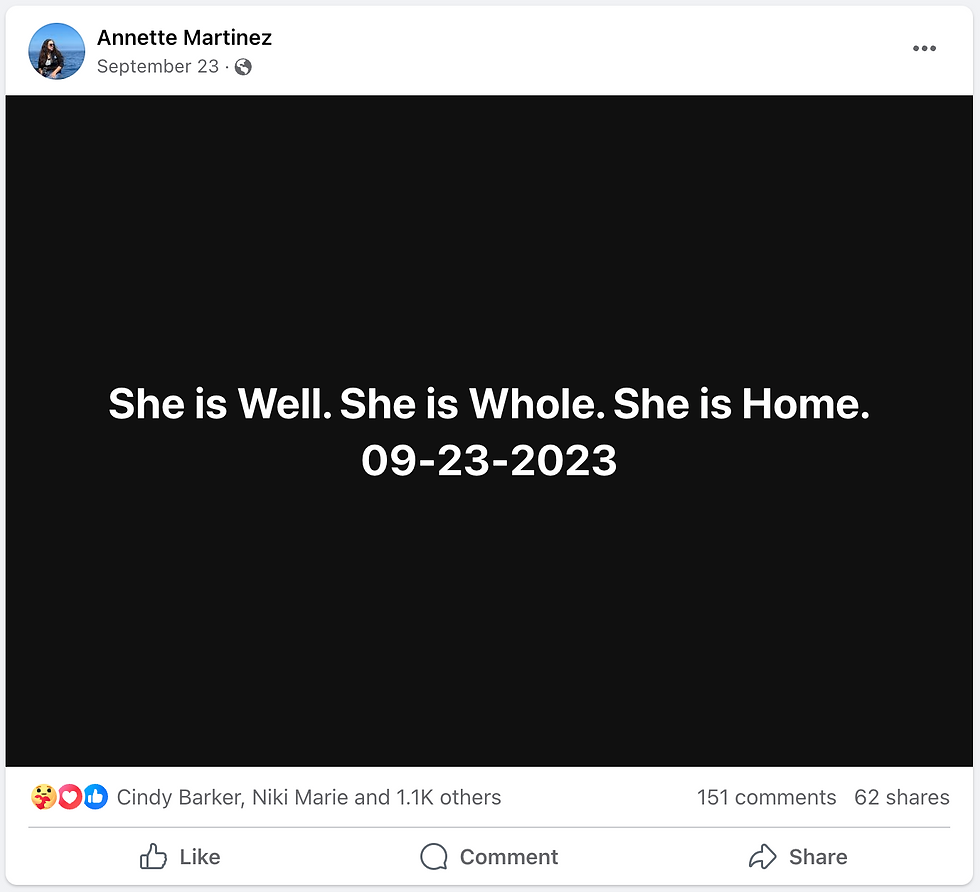
About five hours later we learned that Tokitae’s ashes had been scattered in the Salish Sea, the home from which she originated, the place where her family continues to reside, and the waters to which she was belatedly returned. Some may call the timing a coincidence, I call a sign written into our world. The news came from a post by Annette Martinez, a lifelong advocate for Tokitae, and it read as follows:
If anyone would like to help me, please follow me on Instagram, X, and/or Facebook, Instagram if you pick one. You can also create an account here on the site and comment. Those are the best ways to grow the legitimacy of my site and what I do. In any case, to the community of Orca lovers, thank you for being my new home.
Instagram: https://www.instagram.com/orcawhisperslife/


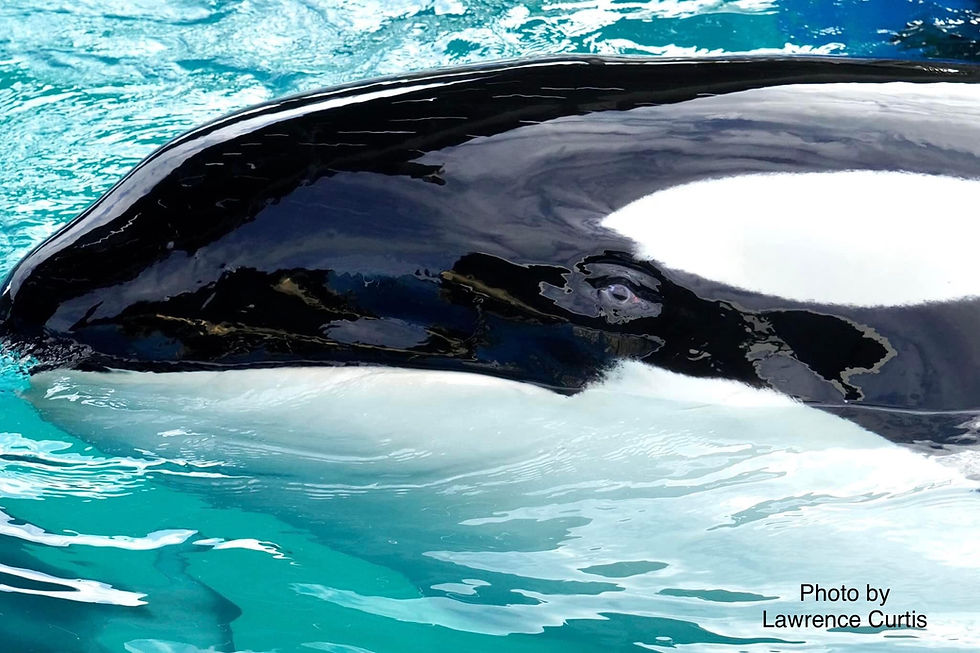
Sk'aliCh'elh-tenaut (Tokitae) died on August 18, 2023. That day, I was on my deck (west side SJI) when I saw a large group of SRKWs in what appeared to be a joyous reunion. They were spy-hopping, tail slapping, porpoising out of the water in what appeared to be a orca party. I was too far away to identify the groups, but have since heard it was a group of J, K, and L pods. The only word I can use is “joyous.” And I completely believe they knew their relative had passed and were welcoming her spirit home. It was amazing, and I cried to see them in their natural habitat without her. I don’t like anthropomorphizing animals but, in…